Pacific Heights Sellers: San Francisco's Real Transfer Tax Cliff Sits at $10 Million, Not $5
September 3, 2026
September 3, 2026
If you've searched for San Francisco's "mansion tax" while pricing a Pacific Heights listing, you've probably read that the big jump happens at $5 million. Several seller guides state it plainly: cross $5 million and your transfer tax rate jumps to 5.5 percent.
That's not what San Francisco's own transfer tax schedule says.
Pull up the official rate table published by the city's Office of the Assessor-Recorder and the math is different. A sale between $5 million and $9,999,999 is taxed at 2.25 percent. The 5.5 percent rate, the one voters approved as Proposition I in 2020, doesn't begin until $10 million. It's a distinction with real dollars attached, and it matters more in Pacific Heights than almost anywhere else in the city, because Pacific Heights is where homes actually cross that specific line.
San Francisco charges a documentary transfer tax any time a deed changes hands, calculated as a tiered percentage of the sale price. The tiers, per the city's published schedule:
| Sale price | Rate |
|---|---|
| $100 to $250,000 | 0.5% |
| $250,000 to $999,999 | 0.68% |
| $1,000,000 to $4,999,999 | 0.75% |
| $5,000,000 to $9,999,999 | 2.25% |
| $10,000,000 to $24,999,999 | 5.5% |
| $25,000,000 and above | 6% |
The mechanic that trips people up: the rate applies to the entire sale price, not just the portion above each threshold. A $10 million sale isn't taxed at 2.25 percent on the first $9,999,999 and 5.5 percent on the last dollar. The whole $10 million is taxed at 5.5 percent. That's what turns a modest price difference into a six-figure tax swing.
Run the numbers at each threshold and the size of the jump tells you which line actually matters.
At $5 million, moving from 0.75 percent to 2.25 percent adds roughly $75,000 in transfer tax. That's real money, but it's a fraction of what happens at the next line.
At $10 million, moving from 2.25 percent to 5.5 percent adds roughly $325,000. This is the jump Proposition I created when San Francisco voters approved it in November 2020, and it's more than four times the size of the $5 million cliff.
At $25 million, moving from 5.5 percent to 6 percent adds roughly $125,000. Meaningful, but smaller again than the $10 million jump.
The $10 million line is the one with the most weight behind it, both in dollar terms and in the amount of press and political attention it's drawn since 2020. It's also the one that gets flattened into "$5 million" in a lot of seller-facing content, probably because $5 million is the first big round number in the schedule and 2.25 percent already feels like a jump. But if you're pricing a home anywhere near either threshold, treating $5 million as the mansion tax line means planning around the wrong number.
Plenty of San Francisco neighborhoods rarely see a sale above $5 million, let alone $10 million. Pacific Heights isn't one of them.
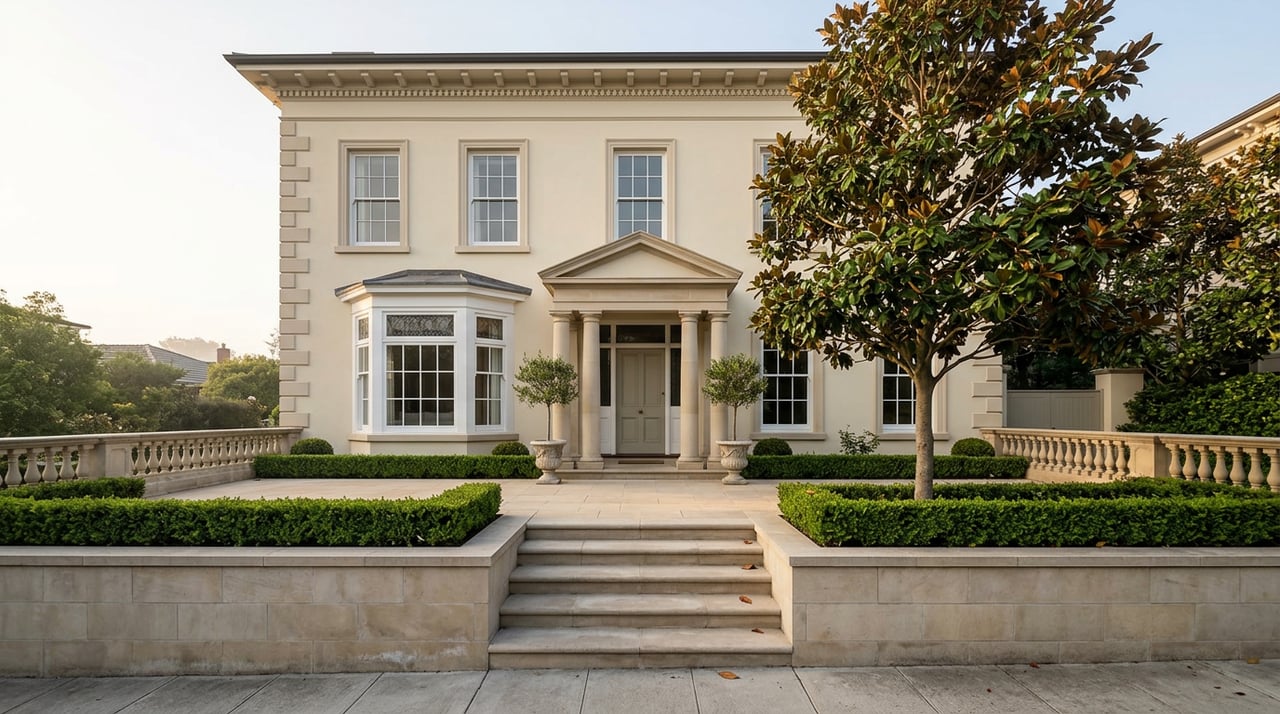
In April 2026, 2830 Pacific Avenue sold at its full $27.5 million asking price after a year on the market, a Georgian Colonial on a street-to-street triple lot. At that price, the transfer tax lands in the top tier: 6 percent, or roughly $1.65 million.
That same month, 2898 Vallejo Street, a roughly 15,000-square-foot Beaux Arts mansion built in 1921, sold off-market for $56 million. Even at a private sale price, the deed still gets recorded and the same 6 percent tier applies, putting the transfer tax bill above $3.3 million.
And in April 2026, the Perry House at 2606 Jackson Street, a modernist outlier among the neighborhood's Victorians, listed for $22.5 million. That price sits inside the $10 million to $25 million tier, meaning a sale anywhere near asking triggers the 5.5 percent rate, not the 2.25 percent rate a seller might expect if they'd been told the mansion tax kicks in at $5 million.
Three listings, three different price points, and all three land well past the $10 million line rather than hovering near $5 million. That's the pattern that makes this neighborhood's math different from a citywide average. Sellers here aren't deciding whether to list at $4.95 million to dodge a modest jump. They're deciding how a home's likely sale price sits relative to a $325,000 tax cliff.
The confusion has a logical root. The rate schedule really does jump at $5 million, from 0.75 percent to 2.25 percent, and that's a real inflection point worth knowing. Proposition I itself, though, only touched the $10 million and $25 million tiers. The measure's own text, and San Francisco's Office of the Controller's contemporaneous analysis of it, both describe an increase on transactions valued at $10 million and above, not $5 million and above.
Somewhere between the ordinance and the seller-facing content built around it, the $5 million tier and the Prop I rate got merged into one story. It's an understandable shortcut. It's also the kind of shortcut that costs a seller real clarity when their home happens to sit in the range where it matters.
If your home could plausibly sell anywhere between roughly $9.5 million and $10.5 million, the $10 million line deserves the same attention buyers and sellers elsewhere in the city give to the $5 million line. San Francisco's transfer tax is customarily paid by the seller, so it comes directly out of net proceeds. A $325,000 swing on a single price decision is worth modeling before you set an asking price, not after an offer comes in.
This isn't a suggestion to underprice a home to dodge a tax bracket. It's a case for asking your agent to run the net sheet at a few different price points before you commit to a number, so the tax consequence is a known variable in the pricing conversation rather than a surprise on the closing statement.
In February 2026, Mayor Daniel Lurie and Supervisor Bilal Mahmood introduced the BUILD Act, legislation that would have rolled the $10 million to $25 million rate back to 2.75 percent and the $25 million-plus rate to 3 percent, closer to where they sat before Proposition I. The proposal moved through an introduction and hold period with a target operative date of July 1, 2026.
It didn't happen. By June 2026, the mayor's office paused the rollback as the city worked through a roughly $936 million budget shortfall, since Proposition I has generated hundreds of millions of dollars for the general fund since 2021 and giving that up required an offset the city hadn't settled on. As of this writing, the rate schedule above, including the 5.5 percent tier at $10 million, remains the one in effect. If you're pricing a home near that threshold today, plan around the rates that exist now rather than a cut that's on hold indefinitely.
Does the buyer ever pay this tax instead of the seller? By custom, San Francisco sellers pay the transfer tax on residential sales, but it's negotiable in the purchase agreement. In competitive situations or new construction, some deals shift the cost to the buyer.
Is the transfer tax the only tax due at closing? No. California also imposes a separate state documentary transfer tax, a much smaller amount administered at the county level. Your title or escrow officer will calculate the exact combined figure at closing.
Could these rates change again? Possibly. The BUILD Act's transfer tax rollback is paused, not withdrawn, and city leaders have said they'll revisit it once they identify a revenue offset. Nothing is scheduled, so any seller pricing near a threshold should work from today's rates rather than a future one.
This post is general information, not tax or legal advice. Confirm your specific transfer tax exposure with your escrow officer and, for anything beyond the basic calculation, a tax professional familiar with San Francisco transactions.
Pricing a Pacific Heights home well means accounting for every line item that touches net proceeds, and the transfer tax is one of the largest on a multimillion-dollar closing statement. Colleen Cotter works through these numbers with sellers before a home ever goes on the market. Request a complimentary market consultation to get a clear picture of where your home sits relative to these thresholds and what that means for your pricing strategy.
Whether clients need an architect, designer, stager, contractor, lender, or friendly counsel, Colleen Cotter Real Estate Group offers invaluable referrals and guidance. Colleen Cotter Real Estate Group has partners across the country and Bay Area including Burlingame, San Mateo, Marin, Silicon Valley, East Bay, Lake Tahoe, Wine Country, Chicago, Los Angeles, and NYC.