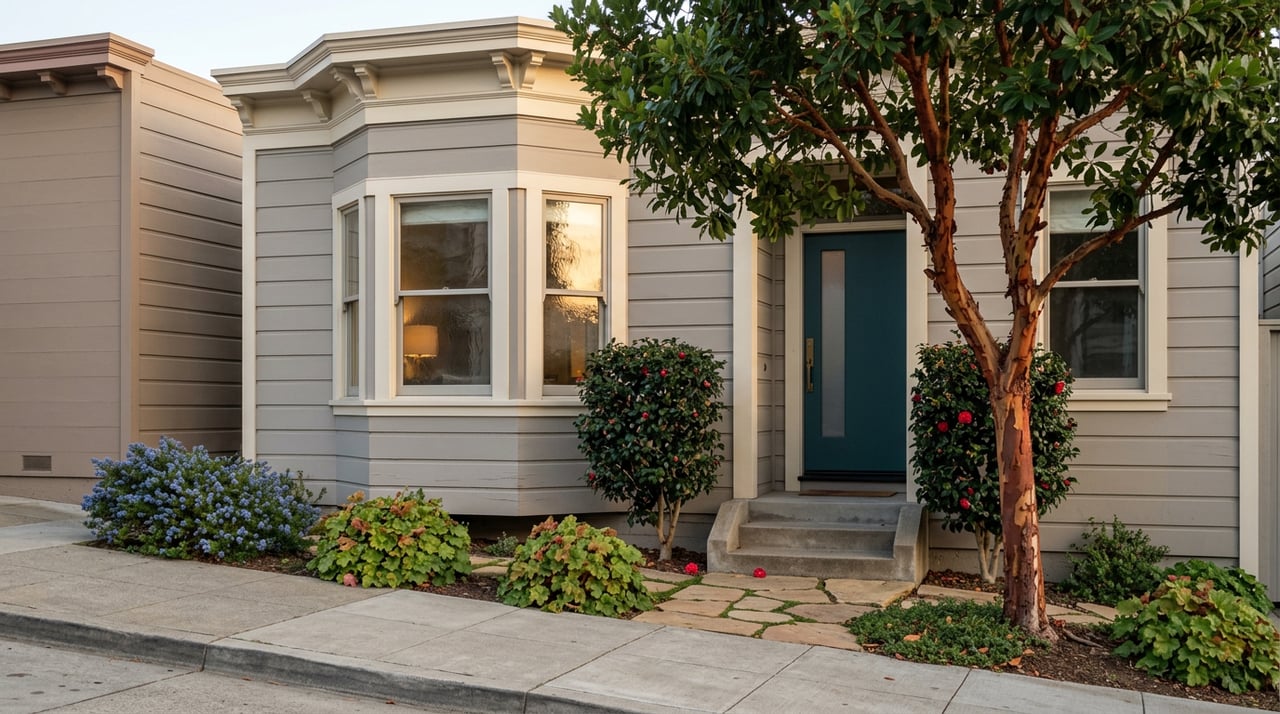
Why Miraloma Park's Portola Drive Still Says Tower Market
August 13, 2026
August 13, 2026
Sign up for a neighborhood cleanup in Miraloma Park and the instructions tell you to meet at Mollie Stone's Tower Market, 635 Portola Drive. Not Mollie Stone's. Tower Market. The store has operated under the Mollie Stone's name since a takeover that the club's own newsletter dated to January 7, 2005, more than two decades ago, and the volunteers organizing cleanups still reach for the old name without thinking twice.
That is not nostalgia. It is a clue about how this neighborhood actually runs. Miraloma Park has almost no commercial strip to speak of, two blocks of Portola Drive doing what a proper Main Street would do in a bigger place, and when a district that small has to carry that much weight, the names attached to its addresses stop belonging to whoever owns the lease. They belong to the neighborhood.
The market's history predates the current owners by decades. According to Mt. Davidson's own account of the store, a Pommon family ran Tower Market from across Portola Drive on Idora Drive, and when the founder died in 1953, his son Dan took over and eventually bought out the small businesses next door to grow the store to 10,000 square feet by 1958. The Pommons sold to John Viglizzo, who ran Viglizzo Meats out of the same building and later told the club's newsletter, "I have been at Tower since 1982." When Mollie Stone's finally took over in January 2005, the new owner told that same newsletter he understood "the passion and commitment in the neighborhood for one of San Francisco's oldest grocery stores."
He was right to flag it. Twenty-plus years later, a Nextdoor business listing still tags the address as Tower Market, and it won a neighborhood favorite designation there in 2023. The signage says Mollie Stone's. The habit says otherwise.
This matters beyond trivia because it tells you something about scarcity. In a neighborhood with three grocery stores, nobody bothers keeping the old name of one that changed hands. In a neighborhood with exactly one, the store's identity becomes public property, something residents feel entitled to preserve regardless of what the ownership paperwork says.
That same scarcity shapes everything else on Portola Drive. Miraloma Park is, as one longtime resident put it in a local writeup, almost entirely residential, with not much in the way of retail. What retail exists sits within a couple of blocks:
Compare that to a commercial corridor in a denser SF neighborhood, where turnover is constant and a closed storefront gets filled within a season by whatever concept is chasing foot traffic that week. Portola Drive doesn't have that churn, because it doesn't have that foot traffic to chase. The businesses that are here aren't competing with a dozen alternatives two blocks over. They're the only version of themselves the neighborhood has, which is exactly why a grocery store can change hands and keep its old name for twenty years. There's no competitor down the street offering a fresher identity to switch to.
If the businesses provide the buildings, the Miraloma Park Improvement Club provides the reason anyone shows up. Incorporated in 1936, the MPIC has published a newsletter called Miraloma Life since 1954, delivered monthly, ten months a year, to roughly 2,200 homes and a handful of local businesses. That newsletter is also where you'll find the neighborhood's actual social calendar, and it reads less like a bulletin board and more like a set of standing appointments.
Second Saturdays bring residents to the MPIC Clubhouse at 350 O'Shaughnessy Boulevard for cleanup shifts, sign-ups handled through the club directly. Beautification days rotate by street, past editions of the newsletter have called out both Marietta Drive and the Los Palmos garden by name. Come October, there's a trunk-or-treat on Halloween itself. There's a National Good Neighbors Day. There's an event the club simply calls Community Cheers, drinks and connection, which is about as honest a description of the neighborhood's social contract as you'll find in print. One issue of the newsletter reported that the neighborhood playground scored 92 percent in the city's annual park maintenance evaluation, the kind of number that would be filler anywhere else and is treated here like a report card.
None of this is commerce. It's civic infrastructure standing in for what a busier retail strip would provide on its own, foot traffic, gathering spots, reasons to run into your neighbors. Even the Miraloma Elementary Fun Run, a school fundraiser, runs on the same logic: check-in at 10:00 a.m., staggered laps by grade starting at 10:45, a picnic at noon, sponsors solicited from the same small pool of local businesses that anchor Portola Drive. The school and the club are pulling from the identical short list of names.
The retail side of Miraloma Park is compact by design, and the neighborhood makes up the difference with what surrounds it. Mount Davidson rises at the western edge, its hiking path entrance sitting at 298 Juanita Way, and the mountain carries its landmark concrete cross above a stretch of undeveloped hillside where, as one local resident who lived there for years described it, the coyotes are vocal at night and the red-tailed hawks soar overhead regularly. Glen Canyon Park sits on the opposite side, threaded by Islais Creek.
Neither park needs a business plan. They were there before Portola Drive had a business district and they'll outlast whatever the next tenant sign says at 635 Portola Drive.
Miraloma Park doesn't have enough commerce to let any single business fade into the background. Every storefront on Portola Drive is doing double duty, retail on one side, informal civic landmark on the other, and the neighborhood's own improvement club has spent ninety years building a calendar of small rituals that keep those two blocks working even when foot traffic alone wouldn't. That's why a store can be sold, renamed, and re-signed, and the neighborhood keeps calling it what it used to be. The name was never really about ownership. It was about which building the whole community had already agreed to depend on.
If you're already living the version of Miraloma Park where everyone still says Tower Market, you don't need this explained to you twice. But if you're weighing what a home near that stretch of Portola Drive is actually worth in today's market, or want a straight read on how a two-block business strip like this holds its value over time, Colleen Cotter is happy to talk it through. Reach out any time to request a complimentary market consultation.
Whether clients need an architect, designer, stager, contractor, lender, or friendly counsel, Colleen Cotter Real Estate Group offers invaluable referrals and guidance. Colleen Cotter Real Estate Group has partners across the country and Bay Area including Burlingame, San Mateo, Marin, Silicon Valley, East Bay, Lake Tahoe, Wine Country, Chicago, Los Angeles, and NYC.